
The SLVTM Micro Powder Ultra-Fine Grinding Mill is a novel piece of equipment designed through the assimilation of foreign technology. It achieves the desired fineness (325–3000 mesh) by grinding material (0–15mm) through the rolling action of pressure-applied grinding rollers against a rotating grinding disc. Its key technical features lie in the thorough contact between the grinding rollers, grinding disc and material, coupled with the precision grading of its classification system. Under identical feed conditions and product fineness specifications, its output capacity triples that of conventional Raymond mills. At equivalent feed conditions and output requirements, it surpasses the fineness of three-ring medium-speed mills by over 500 mesh. Under identical feed conditions, fineness, and output demands, its power consumption amounts to merely 50% of that of air-impact crushers. This machine represents the premier choice for its superior technological sophistication, unrivalled production efficiency, and significant energy savings, surpassing the fineness metrics of wet grinding mills. It is ideally suited for the ultrafine grinding of powdered materials within non-metallic mineral industries, including metallurgy, chemical processing, papermaking, coatings, ceramics, expanded clay aggregate, alumina, and refractory materials.
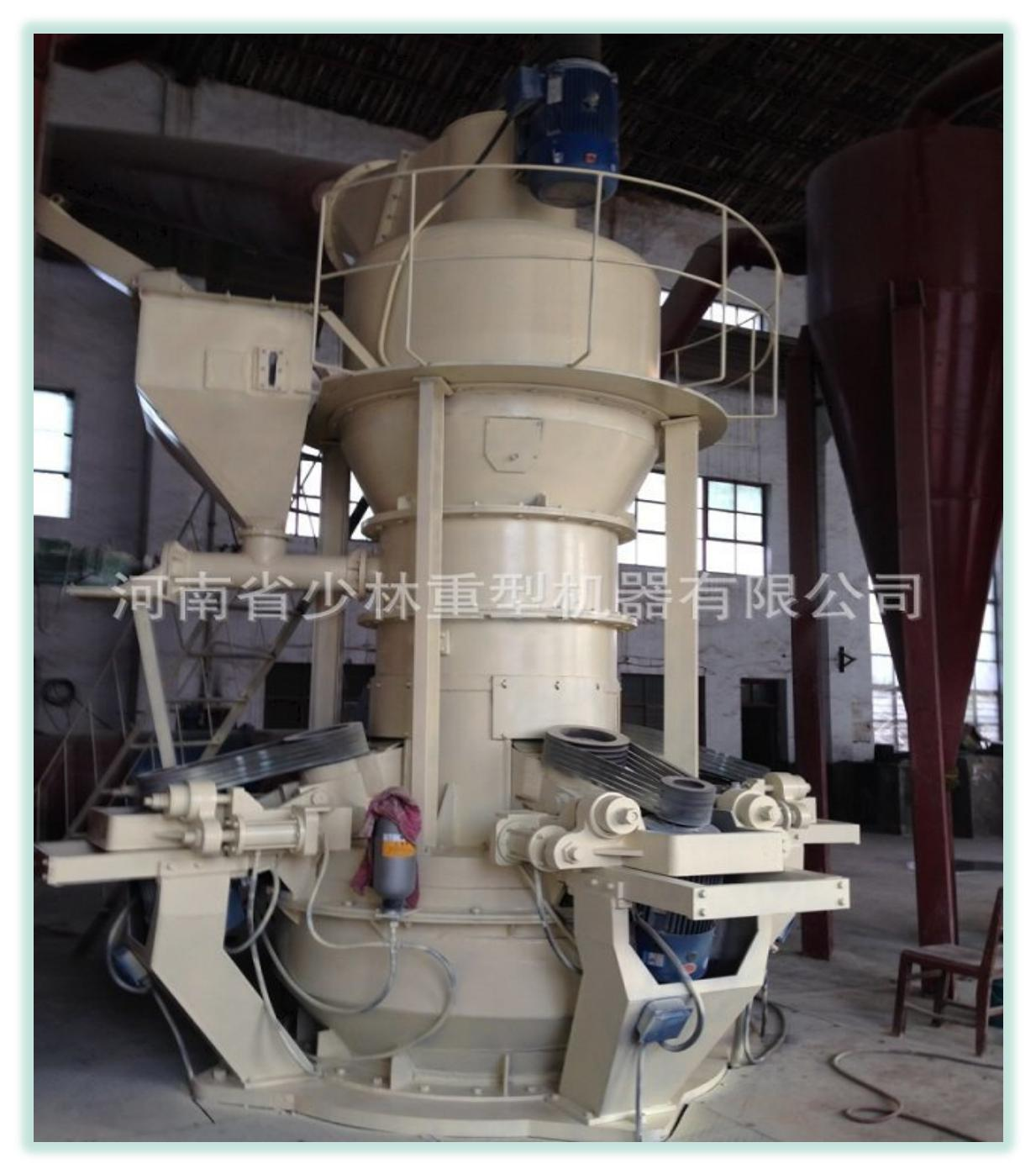
Core Components of the Production Line
A complete MTW grinding production line typically comprises:
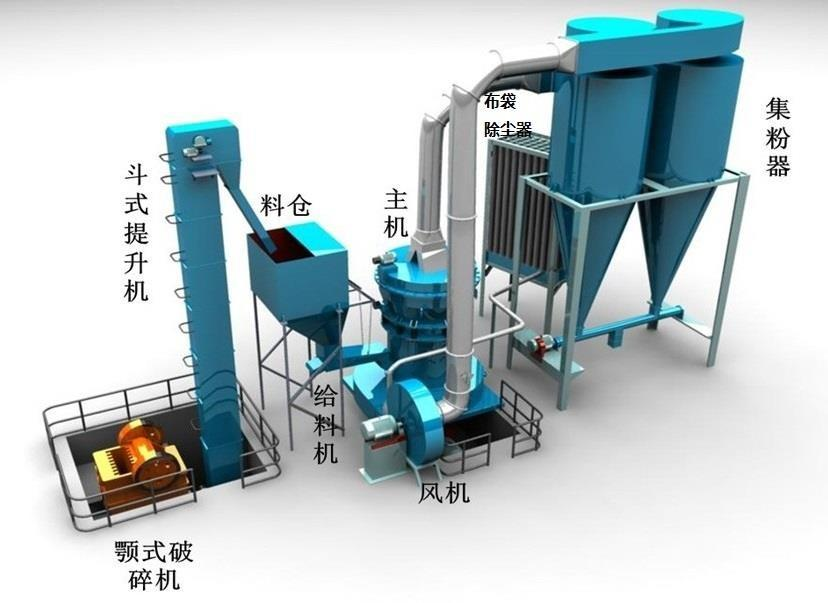
The SLVTM micro-powder ultrafine grinding system primarily comprises a belt conveyor, bucket elevator, regulating hopper, enclosed quantitative feeder, main unit, hot blast furnace, hydraulic lubrication system, dust collector, finished product silo, fan, and silencer. System configurations vary according to processed materials, site constraints, and client preferences, though fundamental designs remain broadly similar. Systems are primarily categorised as open-circuit or closed-circuit. Open-circuit systems discharge airflow directly into the atmosphere without recirculation, whereas closed-circuit systems enable airflow recirculation, minimising energy loss but requiring more extensive pipework and ancillary equipment.
The complete configuration of the SLVTM micro-powder ultrafine mill (see diagram below) comprises:
hammer crusher, bucket elevator, storage silo, feeder, SLVTM micro-powder ultrafine mill, variable-frequency classifier, cyclone collector, pulse dust collection system, etc.
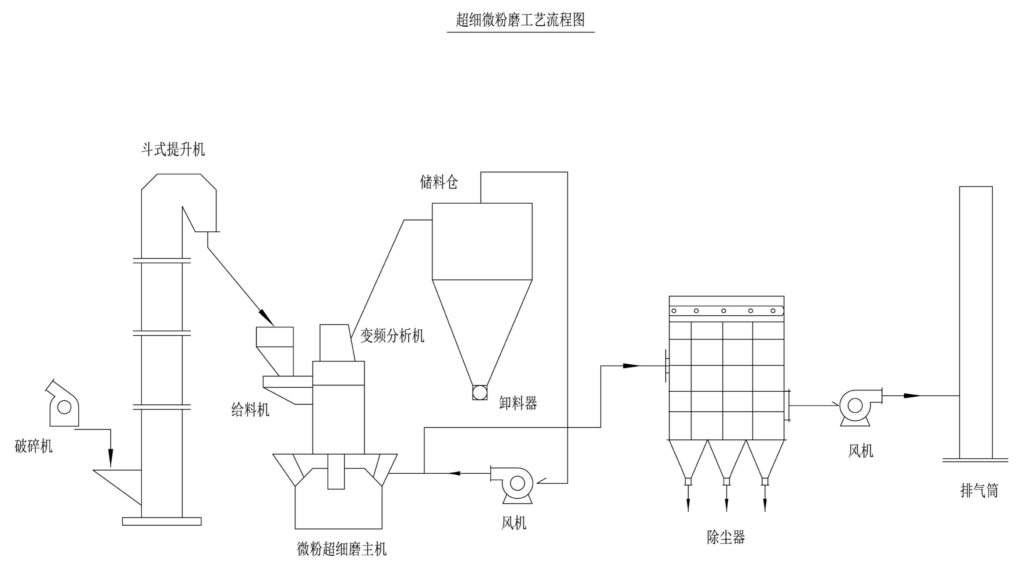
How it works:
After the large bulk material is crushed to the required particle size by the crusher, the material is sent to the storage hopper by the elevator, and then the material is continuously sent into the main engine mill for grinding by the electromagnetic vibration feeder. Under the action of the impeller of the powder separator, the materials that do not meet the fineness requirements fall into the mill chamber for re-milling, and the materials that meet the fineness requirements enter the cyclone powder collector with the airflow through the pipeline for separation and collection, and are discharged through the discharge device to become the finished powder. The separated airflow enters the fan through the return duct at the top of the cyclone powder collector. The system is a closed-circuit circulation system and operates under positive and negative pressures. The entire production system runs under negative pressure closed conditions and is equipped with a pulse collector to prevent dust spillage, which meets national environmental protection standards.
Technical Advantages of the Ultra-Fine Grinding Mill:
The SLVTM Micro-Powder Ultra-Fine Grinding Mill represents a new generation of high-efficiency, low-cost ultra-fine powder processing equipment developed by our company. Drawing upon over two decades of grinding mill manufacturing expertise and incorporating the strengths of domestic and international grinding mill producers, it has been refined through extensive investigation, research, and testing. This mill embodies cutting-edge technology and stands as the latest international innovation in ultra-fine powder processing, designed to replace traditional grinding mills. It has been unanimously recognised as a domestically leading technological product.
Product Features of the Ultra-Fine Grinding Mill
- Low Operating Costs: High grinding efficiency and low power consumption, reducing electricity usage by 40-50% compared to other grinding equipment such as ball mills and Raymond mills. Minimal wear, roller sleeves and liners made from specialised materials ensure extended service life, minimising metal contamination in products and lowering operational expenses. Can be equipped with an external circulation device to further reduce power consumption and enhance product precision.
- Reduced Construction Costs: Compared to ball mill systems, the micro-powder ultra-fine mill occupies approximately 50% less floor space and incurs around 70% lower construction expenses. Its integrated design combining crushing, drying, grinding, classification, and conveying simplifies the system, resulting in cost-effective installation.
- Operational Simplicity and Reliability: Equipped with automated control systems enabling remote operation, the machinery is straightforward to manage. Features include anti-contact devices preventing direct roller sleeve-grinding disc liner interaction and vibration-damping springs, eliminating destructive vibrations.
- Maintenance Ease: Roller sleeves and wear-resistant inner rings can be replaced rapidly via the maintenance cylinder sliding carriage.
- Minimal Environmental Impact: Low vibration and noise levels. The system operates under negative pressure, preventing dust leakage.
- Consistent Product Quality: Short residence time within the mill facilitates precise monitoring and control of particle size and chemical composition. The integrated high-precision classifier efficiently grades products from 325 mesh to 3000 mesh, delivering exceptional grading accuracy, precise particle size control, and stable product quality.
- Minimised external iron contamination: Internal contact surfaces, classifier impellers, and pipelines feature isolated wear-resistant protection. Grinding rings and rollers utilise ultra-hard, high-compression wear-resistant materials, virtually eliminating external iron ingress.